nnnnnnnnnnnn TOP nnnnnnnnnnnnn
Cool dry season
***** Location: Kenya
***** Season: Cool dry season
***** Category: Season
*****************************
Explanation
This is one of the four seasons we have in Kenya and other tropical areas.
It lasts roughly from June to September, with July being the coldest month.
xxxxxxxxxxxxxxxxxxxxxxxxxxxxx
*****************************
Worldwide use
*****************************
Things found on the way
*****************************
HAIKU
green grass turns brown
and the maize heavy with corn...
cold dry season
Patrick Wafula, Kenya
xxxxxxxxxxxxxxxxxxxxxxxxxxxxx
*****************************
Related words
*****
*****************************
THE KENYA SAIJIKI
Please send your contributions to
Gabi Greve / Isabelle Prondzynski
worldkigo .....
Back to the WHC Worldkigo Index
3/15/2005

3/01/2005
Cassia Blossom
[ . BACK to Worldkigo TOP . ]
:::::::::::::::::::::::::::::::::::::::::::::::::::::::::::::::::::::::::::::::::::::::::::::::::::::
Cassia blossoms
***** Location: Kenya, India, Tropics
***** Season: Hot dry season
***** Category: Plant
*****************************
Explanation
An easily recognised genus of over 500 species, most of which contain a laxative chemical in the leaves or fruit pulp. Cassia senna, a shrub found from Egypt to India, is the main source of the well-known medicine of that name.
A number of exotic and indigenous tree species are widespread in Kenya, preferring open, sunny positions and well-drained soil. All have cylindrical pods and flowers with 5 petals and up to 10 stamens, often unequal in size.
Cassia spectabilis (Family : Caesalpiniaceae)
A rounded, deciduous trees to 10 m, bearing showy clusters of yellow flowers, widely planted up to 2,000 m and very common around Nairobi.
Bark : smooth, grey with horizontal markings; rougher with age.
Leaves : compound, up to 40 cm in length, with 4 to 15 pairs of leaflets, each up to 7.5 cm; leaflets narrowly elliptic, tapering to the apex, usually softly hairy below. Leaves are shed entirely, leaving the tree bare for many months.
Flowers : bright golden yellow, in erect pyramid-shaped spikes 30 cm or more in length.
Fruit : up to 30 cm long, cylindrical or flattened, honeycombed into horizontal seed chambers, persistent, turning from green to black.
Practical notes : quick-growing, flourishing even in poor or black-cotton soil, but not at its best if the site is too dry. Spectacular in flower and deservedly popular; widely obtainable from nurseries.
-- Trees of Kenya, Tim Noad and Ann Birnie, 1989.
..................................................................................................

Photos: Isabelle Prondzynski
:::::::::::::::::::::::::::::::::::::::::::::::::::::::::::::::::::::::::::::::::::::::::::::::::::::
This fast-growing, smallish, deciduous tree originates from tropical America and reaches a height of about 30 ft (10 m). Its rounded and somewhat spreading outline bears large, handsome and erect terminal spikes of bright yellow blossoms and is a magnificent sight when in bloom. It is a prominent sight in and around Nairobi.
-- The beautiful plants of Kenya, John Karmali, 1988.
xxxxxxxxxxxxxxxxxxxxxxxxxxxxx
Have a look at this beautiful picture of the Presidential Way in Lilingwe, Malawi, lined with flowering cassia spectabilis :
http://www.biologie.uni-hamburg.de/b-online/afrika/malawi/lilongwe.htm
Caesalpinia gilliesii (Bird of Paradise Flower)

Shrubs growing in abandoned field near Mafikeng (Northwest, South Africa).
This species originates from Argentina and Uruguay.
*****************************
Worldwide use
The cassia originates in Latin America :
http://www.arbolesornamentales.com/Cassiaspectabilis.htm
In Australia, a yellow flowering cassia shrub is a kigo for autumn :
http://users.mullum.com.au/jbird/jb_H_seasons_notes.html
Cassia siamea growing in Hawaii :
http://www2.ctahr.hawaii.edu/forestry/Data/Species_Pages/Page_S.html#senna%20siamea
:::::::::::::::::::::::::::::::::::::::::::::::::::::::::::::::::::::::::::::::::::::::::::::::::::
INDIA
Amaltaas blossoms
Hindi: bendra lathi (or bandarlauri), dhanbaher (or dhanbohar), girimaloah
Hindi and Urdu: amaltās (अमलतास)
Marathi: bahava (बहावा)
Malayalam: kanikkonna (or kani konna : Kerala), Vishu konna
Meitei (Manipuri): chahui
Nepali: amaltash, rajbriksya
Sanskrit: aragvadha, chaturangula, kritamala, suvarnaka
Sinhalese: aehaela-gaha (or ahalla-gass), ekela
Tamil: konrai (கொன்ற)
kigo for summer
The Golden Shower Tree (pruging cassia) (Cassia fistula) is a flowering plant in the family Fabaceae, native to southern Asia, from southern Pakistan east through India to Myanmar and south to Sri Lanka.
In Ayurvedic medicine, Golden Shower Tree is known as aragvadha ("disease killer"). Its fruitpulp is used as mild laxative, against fevers, arthritis, vatavyadhi (nervous system diseases), all kinds of rakta-pitta (bleeding, such as hematemesis or hemorrhages), as well as cardiac conditions and stomach problems such as acid reflux. The root is considered a very strong purgative, and self-medication or any use without medical supervision is strongly advised against in Ayurvedic texts.
The Golden Shower Tree was named Cassia fistula by Carl Linnaeus. The name was erroneously used by John Patrick Micklethwait Brenan for the Kenyan Shower Cassia, correctly known as C. afrofistula. Similarly, Francisco Manuel Blanco misapplied Linnaeus's name to the Apple-blossom Cassia subspecies C. javanica ssp. javanica.
© More in the WIKIPEDIA !

the amaltaas
blooms bright yellow in the sun--
green leaves go hiding
hot wind all day--
golden chains of amaltaas
blowing away
Sunil Uniyal, India, May 2008
.................................................................................
Amaltaas In Punjabi: ਅਮਲਤਾਸ
In Hindi: अमलतास
walking under
the canopy of amaltaas --
a sudden shower
Sandip Sital Chauhan
:::::::::::::::::::::::::::::::::::::::::::::::::::::::::::::::::::::::::::::::::::::::::::::::::::::
"Drumstick tree"
This name is also used for the golden shower tree (Cassia fistulosa).
Moringa oleifera (synonym: Moringa pterygosperma)
is the most widely cultivated species of the genus Moringa, which is the only genus in the family Moringaceae. English common names include moringa, benzolive tree, and West Indian ben. It is also known as drumstick tree, from the appearance of the long, slender, triangular seed pods, horseradish tree, from the taste of the roots which resembles horseradish, or ben oil tree, from the oil derived from the seeds.

The tree itself is rather slender, with drooping branches that grow to approximately 10m in height. In cultivation, it is often cut back annually to 1-2 metres and allowed to regrow so the pods and leaves remain within arm's reach.
© More in the WIKIPEDIA !
light drizzle -
beneath the drumstick tree
i imitate the koel
- Shared by Rosie Mann, Punjab -
Joys of Japan, 2012
INDIA SAIJIKI
*****************************
Things found on the way
Senna is a powerful cathartic used in the treatment of constipation, working through a stimulation of intestinal peristalsis.
Official Latin Name: Cassia angustifolia
http://www.viable-herbal.com/singles/herbs/s530.htm
*****************************
HAIKU
cassia blossom --
walking to the market
full of light
market stalls
laden with fruit
cassia with bloom
half moon and sun
both in Nairobi skies
its cassia flowers
Isabelle Prondzynski
:::::::::::::::::::::::::::::::::::::::::::::::::::::::::::::::::::::::::::::::::::::::::::::::::::::
hot season--
a cassia tree trunk peels off
the old bark
Barrack Elung'ata
February 2011
*****************************
Related words
***** Cassia, nanban saikachi (ナンバン サイカチ) Japan
南蛮皀莢
It only grows in limited warm areas of Okinawa.
:::::::::::::::::::::::::::::::::::::::::::::::::::::::::::::::::::::::::::::::::::::::::::::::::::::
[ . BACK to Worldkigo TOP . ]
:::::::::::::::::::::::::::::::::::::::::::::::::::::::::::::::::::::::::::::::::::::::::::::::::::::
:::::::::::::::::::::::::::::::::::::::::::::::::::::::::::::::::::::::::::::::::::::::::::::::::::::
Cassia blossoms
***** Location: Kenya, India, Tropics
***** Season: Hot dry season
***** Category: Plant
*****************************
Explanation
An easily recognised genus of over 500 species, most of which contain a laxative chemical in the leaves or fruit pulp. Cassia senna, a shrub found from Egypt to India, is the main source of the well-known medicine of that name.
A number of exotic and indigenous tree species are widespread in Kenya, preferring open, sunny positions and well-drained soil. All have cylindrical pods and flowers with 5 petals and up to 10 stamens, often unequal in size.
Cassia spectabilis (Family : Caesalpiniaceae)
A rounded, deciduous trees to 10 m, bearing showy clusters of yellow flowers, widely planted up to 2,000 m and very common around Nairobi.
Bark : smooth, grey with horizontal markings; rougher with age.
Leaves : compound, up to 40 cm in length, with 4 to 15 pairs of leaflets, each up to 7.5 cm; leaflets narrowly elliptic, tapering to the apex, usually softly hairy below. Leaves are shed entirely, leaving the tree bare for many months.
Flowers : bright golden yellow, in erect pyramid-shaped spikes 30 cm or more in length.
Fruit : up to 30 cm long, cylindrical or flattened, honeycombed into horizontal seed chambers, persistent, turning from green to black.
Practical notes : quick-growing, flourishing even in poor or black-cotton soil, but not at its best if the site is too dry. Spectacular in flower and deservedly popular; widely obtainable from nurseries.
-- Trees of Kenya, Tim Noad and Ann Birnie, 1989.
..................................................................................................
Photos: Isabelle Prondzynski
:::::::::::::::::::::::::::::::::::::::::::::::::::::::::::::::::::::::::::::::::::::::::::::::::::::
This fast-growing, smallish, deciduous tree originates from tropical America and reaches a height of about 30 ft (10 m). Its rounded and somewhat spreading outline bears large, handsome and erect terminal spikes of bright yellow blossoms and is a magnificent sight when in bloom. It is a prominent sight in and around Nairobi.
-- The beautiful plants of Kenya, John Karmali, 1988.
xxxxxxxxxxxxxxxxxxxxxxxxxxxxx
Have a look at this beautiful picture of the Presidential Way in Lilingwe, Malawi, lined with flowering cassia spectabilis :
http://www.biologie.uni-hamburg.de/b-online/afrika/malawi/lilongwe.htm
Caesalpinia gilliesii (Bird of Paradise Flower)
Shrubs growing in abandoned field near Mafikeng (Northwest, South Africa).
This species originates from Argentina and Uruguay.
*****************************
Worldwide use
The cassia originates in Latin America :
http://www.arbolesornamentales.com/Cassiaspectabilis.htm
In Australia, a yellow flowering cassia shrub is a kigo for autumn :
http://users.mullum.com.au/jbird/jb_H_seasons_notes.html
Cassia siamea growing in Hawaii :
http://www2.ctahr.hawaii.edu/forestry/Data/Species_Pages/Page_S.html#senna%20siamea
:::::::::::::::::::::::::::::::::::::::::::::::::::::::::::::::::::::::::::::::::::::::::::::::::::
INDIA
Amaltaas blossoms
Hindi: bendra lathi (or bandarlauri), dhanbaher (or dhanbohar), girimaloah
Hindi and Urdu: amaltās (अमलतास)
Marathi: bahava (बहावा)
Malayalam: kanikkonna (or kani konna : Kerala), Vishu konna
Meitei (Manipuri): chahui
Nepali: amaltash, rajbriksya
Sanskrit: aragvadha, chaturangula, kritamala, suvarnaka
Sinhalese: aehaela-gaha (or ahalla-gass), ekela
Tamil: konrai (கொன்ற)
kigo for summer
The Golden Shower Tree (pruging cassia) (Cassia fistula) is a flowering plant in the family Fabaceae, native to southern Asia, from southern Pakistan east through India to Myanmar and south to Sri Lanka.
In Ayurvedic medicine, Golden Shower Tree is known as aragvadha ("disease killer"). Its fruitpulp is used as mild laxative, against fevers, arthritis, vatavyadhi (nervous system diseases), all kinds of rakta-pitta (bleeding, such as hematemesis or hemorrhages), as well as cardiac conditions and stomach problems such as acid reflux. The root is considered a very strong purgative, and self-medication or any use without medical supervision is strongly advised against in Ayurvedic texts.
The Golden Shower Tree was named Cassia fistula by Carl Linnaeus. The name was erroneously used by John Patrick Micklethwait Brenan for the Kenyan Shower Cassia, correctly known as C. afrofistula. Similarly, Francisco Manuel Blanco misapplied Linnaeus's name to the Apple-blossom Cassia subspecies C. javanica ssp. javanica.
© More in the WIKIPEDIA !
the amaltaas
blooms bright yellow in the sun--
green leaves go hiding
hot wind all day--
golden chains of amaltaas
blowing away
Sunil Uniyal, India, May 2008
.................................................................................
Amaltaas In Punjabi: ਅਮਲਤਾਸ
In Hindi: अमलतास
walking under
the canopy of amaltaas --
a sudden shower
Sandip Sital Chauhan
:::::::::::::::::::::::::::::::::::::::::::::::::::::::::::::::::::::::::::::::::::::::::::::::::::::
"Drumstick tree"
This name is also used for the golden shower tree (Cassia fistulosa).
Moringa oleifera (synonym: Moringa pterygosperma)
is the most widely cultivated species of the genus Moringa, which is the only genus in the family Moringaceae. English common names include moringa, benzolive tree, and West Indian ben. It is also known as drumstick tree, from the appearance of the long, slender, triangular seed pods, horseradish tree, from the taste of the roots which resembles horseradish, or ben oil tree, from the oil derived from the seeds.

The tree itself is rather slender, with drooping branches that grow to approximately 10m in height. In cultivation, it is often cut back annually to 1-2 metres and allowed to regrow so the pods and leaves remain within arm's reach.
© More in the WIKIPEDIA !
light drizzle -
beneath the drumstick tree
i imitate the koel
- Shared by Rosie Mann, Punjab -
Joys of Japan, 2012
INDIA SAIJIKI
*****************************
Things found on the way
Senna is a powerful cathartic used in the treatment of constipation, working through a stimulation of intestinal peristalsis.
Official Latin Name: Cassia angustifolia
http://www.viable-herbal.com/singles/herbs/s530.htm
*****************************
HAIKU
cassia blossom --
walking to the market
full of light
market stalls
laden with fruit
cassia with bloom
half moon and sun
both in Nairobi skies
its cassia flowers
Isabelle Prondzynski
:::::::::::::::::::::::::::::::::::::::::::::::::::::::::::::::::::::::::::::::::::::::::::::::::::::
hot season--
a cassia tree trunk peels off
the old bark
Barrack Elung'ata
February 2011
*****************************
Related words
***** Cassia, nanban saikachi (ナンバン サイカチ) Japan
南蛮皀莢
It only grows in limited warm areas of Okinawa.
:::::::::::::::::::::::::::::::::::::::::::::::::::::::::::::::::::::::::::::::::::::::::::::::::::::
[ . BACK to Worldkigo TOP . ]
:::::::::::::::::::::::::::::::::::::::::::::::::::::::::::::::::::::::::::::::::::::::::::::::::::::
Caladium (Elephant Ears)
[ . BACK to WORLDKIGO . TOP . ]
:::::::::::::::::::::::::::::::::::::::::::::::::::::::::::::::::::::::::::::::::::::::::::::::::::::
Caladium (Elephant Ears)
***** Location: Tropical Areas, Trinidad and Tobago
***** Season: Tropical Rainy Season
***** Category: Plant
*****************************
Explanation

http://www.ces.ncsu.edu/depts/hort/consumer/poison/Caladsp.htm
The Caladium or Elephant Ears,
left to thrive naturally, will appear as if by magic out of the soil; throwing up large heartshaped decorative leaves, on thin langly succulent stalks; around the last week of May; making the statement Rainy season - is - a - coming.
The leaves range from bright pink and green, to red and green, and toning down into the range-- white and green.
They love the rain and can grow and flourish into leaf sizes of about thirty seven by thirty two centimeters (37x32cm). Around late July early August they blossom a sort of lily which looks very much like the bloom of the Chinese Evergreen (Aglonema commutatum).
Late September they start drying out, the root will remain in the soil until next May. When they start their beautiful magic all over again.
Gillena Cox
Link with more text and a lot of pictures:

http://www.botany.com/8.5.gif
http://www.botany.com/8.44.gif
http://www.botany.com/caladium.htm
::::::::::::::::::::::::::::::::::::::::::::::::::::::::::::::::::::::::::::::::::::::::
Mass plantings of caladiums create a focal point in the landscape. They provide a striking contrast with the green foliage of other plants, especially when planted in the foreground.
Caladiums need protection from full sun for best growth and color. Some newer varieties will tolerate full sun for a couple of hours daily, but all prefer dappled or moderate shade.
http://hgic.clemson.edu/factsheets/HGIC1160.htm
It is also a poisonous plant:
TOXIC ONLY IF LARGE QUANTITIES EATEN. CAUSES SEVERE PAIN IN THE MOUTH IF EATEN! SKIN IRRITATION MINOR, OR LASTING ONLY FOR A FEW MINUTES.
http://www.ces.ncsu.edu/depts/hort/consumer/poison/Caladsp.htm
*****************************
Worldwide Use
Japan
karajiuumu, karajuumu カラジューム Calladium
kigo for late summer
*****************************
Things found on the way
*****************************
HAIKU
after the cats fight
elephant ears unearthed
lay prostrate
Gillena Cox, 2003
xxxxxxxxxxxxxxxxxxxxxxxxxxxxxxx
tropical storm
elephant's ears bob
in the wind
Cindy
http://haiku.cc.ehime-u.ac.jp/~shiki/shiki-workshop.archive/html/199808/0132.html
:::::::::::::::::::::::::::::::::::::::::::::::::::::::::::::::::::::::::::::::::::::::::::::::::::::

A place of shelter...
Caladiums surround me...
The bugs feel secure...
Kris Bishop
source : haikuart.blogspot.jp
*****************************
Related words
***** . PLANTS - - - the Complete SAIJIKI .
[ . BACK to WORLDKIGO . TOP . ]
:::::::::::::::::::::::::::::::::::::::::::::::::::::::::::::::::::::::::::::::::::::::::::::::::::::
:::::::::::::::::::::::::::::::::::::::::::::::::::::::::::::::::::::::::::::::::::::::::::::::::::::
Caladium (Elephant Ears)
***** Location: Tropical Areas, Trinidad and Tobago
***** Season: Tropical Rainy Season
***** Category: Plant
*****************************
Explanation
http://www.ces.ncsu.edu/depts/hort/consumer/poison/Caladsp.htm
The Caladium or Elephant Ears,
left to thrive naturally, will appear as if by magic out of the soil; throwing up large heartshaped decorative leaves, on thin langly succulent stalks; around the last week of May; making the statement Rainy season - is - a - coming.
The leaves range from bright pink and green, to red and green, and toning down into the range-- white and green.
They love the rain and can grow and flourish into leaf sizes of about thirty seven by thirty two centimeters (37x32cm). Around late July early August they blossom a sort of lily which looks very much like the bloom of the Chinese Evergreen (Aglonema commutatum).
Late September they start drying out, the root will remain in the soil until next May. When they start their beautiful magic all over again.
Gillena Cox
Link with more text and a lot of pictures:
http://www.botany.com/8.5.gif
http://www.botany.com/8.44.gif
http://www.botany.com/caladium.htm
::::::::::::::::::::::::::::::::::::::::::::::::::::::::::::::::::::::::::::::::::::::::
Mass plantings of caladiums create a focal point in the landscape. They provide a striking contrast with the green foliage of other plants, especially when planted in the foreground.
Caladiums need protection from full sun for best growth and color. Some newer varieties will tolerate full sun for a couple of hours daily, but all prefer dappled or moderate shade.
http://hgic.clemson.edu/factsheets/HGIC1160.htm
It is also a poisonous plant:
TOXIC ONLY IF LARGE QUANTITIES EATEN. CAUSES SEVERE PAIN IN THE MOUTH IF EATEN! SKIN IRRITATION MINOR, OR LASTING ONLY FOR A FEW MINUTES.
http://www.ces.ncsu.edu/depts/hort/consumer/poison/Caladsp.htm
*****************************
Worldwide Use
Japan
karajiuumu, karajuumu カラジューム Calladium
kigo for late summer
*****************************
Things found on the way
*****************************
HAIKU
after the cats fight
elephant ears unearthed
lay prostrate
Gillena Cox, 2003
xxxxxxxxxxxxxxxxxxxxxxxxxxxxxxx
tropical storm
elephant's ears bob
in the wind
Cindy
http://haiku.cc.ehime-u.ac.jp/~shiki/shiki-workshop.archive/html/199808/0132.html
:::::::::::::::::::::::::::::::::::::::::::::::::::::::::::::::::::::::::::::::::::::::::::::::::::::

A place of shelter...
Caladiums surround me...
The bugs feel secure...
Kris Bishop
source : haikuart.blogspot.jp
*****************************
Related words
***** . PLANTS - - - the Complete SAIJIKI .
[ . BACK to WORLDKIGO . TOP . ]
:::::::::::::::::::::::::::::::::::::::::::::::::::::::::::::::::::::::::::::::::::::::::::::::::::::
Caterpillars Kenya
nnnnnnnnnnnn TOP nnnnnnnnnnnnn
Hairy Caterpillar
***** Location: Kenya
***** Season: Hot dry season
***** Category: Animal
*****************************
Explanation
Hairy caterpillars, during the hot dry season, when they have not yet matured into butterflies or moths, venture into our houses, we know not why, sometimes in considerable numbers, but each moving about independently of the others. We may then come across them in unexpected places, in the kitchen or even on our beds.
If we notice them, we do not touch them -- but we may be unlucky if they escape our notice. Their hairs have the ability to enter our skin and break off there, causing highly allergic reactions and even inflammations. No animal will eat them, so far as we know. The hairy skins, even when shed, keep their ability to cause skin irritations when touched.
They do not seem to eat things in the house, so their desire to come and join us, remains a puzzle. Many evenings have their moments of scooping up the black beasts, which shape themselves into perfect circles as they are transported out on the dustpan and thrown over the garden wall...
The caterpillars are most often black, white, or grey. It is the black one which come into the house -- the grey ones like to eat the geranium leaves in my garden. They are smaller and less beautiful, but much more visibly active.
I have not yet managed to work out which caterpillar becomes which butterfly. Most Kenyan butterflies are extremely beautiful, so one develops a certain amount of compassion for the caterpillars...
Isabelle Prondzynski
This photograph resembles the caterpillars that enjoy my geraniums :
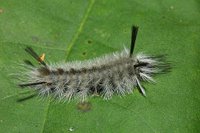
© 2002 Troy Bartlett
Pale Tussock Moth Caterpillar, Halysidota tessellaris
http://troyb.com/photo/gallery/00007443.htm
xxxxxxxxxxxxxxxxxxxxxxxxxxxxx
Great collection of pictures :
http://troyb.com/photo/gallery/section47.htm
xxxxxxxxxxxxxxxxxxxxxxxxxxxxx
Nuisance bugs of Laikipia (Kenya)
by Truman Young
Hairy caterpillars are the larvae of several species of tiger moths. They all look softly hairy, like a cashmere sweater. Unfortunately, many of these hairs are sharp, brittle, and irritant. Even a casual touch (I am sure the caterpillar would disagree) can result in dozens of hairs penetrating the skin. Not actually dangerous, but I have seen a bad reaction to them. When they are about, check your bedding, towels, clothes and shoes before use.
In some years, the all-black ones invade homes. The year 2001 will be remembered in our Segera house as the year of the hairy caterpillars. [Mpala was largely exempt, perhaps because there are no gardens around the buildings.] In the bush, one finds a pretty black and orange striped species, or one that is all black except the orange head. But the one that invades homes is entirely black. I think they are attracted to irrigated gardens.
On one memorable evening, I removed 40 of these little devils from our house. A few days later, I awoke to find one crawling on my pillow, inches from my face. Over a six-week period, I had a dozen "hits" and literally hundreds of hairs implanted. The ones we couldn't remove just worked their way into our flesh, and disappeared, often leaving a mean itch. However, one did fester and cause my finger to swell up considerably. I shook three hairy caterpillars out of my son's shoe this morning.
A nasty story: Keith Lindsay, a friend of ours, was doing his doctoral work in Amboseli back in the early 1980s. One evening while he was sleeping, one if these caterpillars dropped on his eyelid. His friends spent a long time gently tweezing out as many of the hairs as they could find, but the hairs are very brittle and many had broken off at skin level. His eyelid itched a bit, but he seemed OK. A few days later, he began to feel a different kind of itching in his eye. It felt like something was scratching his eyeball. The remaining hairs had worked their way down through the eyelid, and were now coming out the inner side! So now the job was to periodically peel the eyelid back, and tweeze these hairs out as they appeared. This is a true story.
http://tpyoung.ucdavis.edu/NuisanceBugs.htm
xxxxxxxxxxxxxxxxxxxxxxxxxxxxx
You burrowed into my heart like a hairy caterpillar,
I couldn't t stop you, I've got no insect killer
But hairy caterpillars become butterflies
Now I've those in my stomach when you are nearby!!
I LOVE YOU !!
Written by Maria Knight
http://www.lovelandia.com/archive/016863.html
xxxxxxxxxxxxxxxxxxxxxxxxxxxxx
Certain moth caterpillars are covered in hairs so that they look soft and furry, they are common worldwide, but only the South American species are really noxious. Children may find these miniature moving teddies attractive and wish to pick them up. When a child picks up such a caterpillar, falls on one, brushes against one or one gets inside the clothing; the "hairs"
penetrate the skin and cause pain and irritation.
http://www.travellingwithchildren.co.uk/m_health/9_4.htm#Hairy%20Caterpillars
xxxxxxxxxxxxxxxxxxxxxxxxxxxxx
Have a look at the beautiful -- and exciting! -- photographs on the web site given below. These photos are copyrighted, please do not take them for your own website.
The one on the first link most closely resembles those unidentified black hairy caterpillars which visit our Kenyan homes during those hot dry months :
http://www.javajane.co.uk/Hairy/slides/fox_moth.html
And a whole lot more are here :
http://www.javajane.co.uk/Hairy/index.html
*****************************
Worldwide use
Caterpillars, a worldwide KIGO
*****************************
Things found on the way
*****************************
HAIKU
hairy caterpillar --
five fingers stretch out to touch
that black fleece
Isabelle Prondzynski
xxxxxxxxxxxxxxxxxxxxxxxxxxxxx
Short summer night.
A dewdrop
On the back of a hairy caterpillar.
Buson Yosa (1716 ~ 1783)
http://www.big.or.jp/~loupe/links/ehisto/ebuson.shtml
xxxxxxxxxxxxxxxxxxxxxxxxxxxxx
that one time
my heart so merciless
I burned a hairy caterpillar
Masajo Suzuki
http://www.millikin.edu/haiku/courses/globalSpring2005/HaikuUnitPlan/appendix04.html
xxxxxxxxxxxxxxxxxxxxxxxxxxxxx
Would that I could learn. . .
From hairy caterpillar
To colored butterfly.
http://media.wiley.com/product_data/excerpt/9X/07879692/078796929X.pdf
*****************************
Related words
***** Caterpillars, a worldwide KIGO
*****************************
THE KENYA SAIJIKI
Please send your contributions to
Gabi Greve / Isabelle Prondzynski
worldkigo .....
Back to the WHC Worldkigo Index
Hairy Caterpillar
***** Location: Kenya
***** Season: Hot dry season
***** Category: Animal
*****************************
Explanation
Hairy caterpillars, during the hot dry season, when they have not yet matured into butterflies or moths, venture into our houses, we know not why, sometimes in considerable numbers, but each moving about independently of the others. We may then come across them in unexpected places, in the kitchen or even on our beds.
If we notice them, we do not touch them -- but we may be unlucky if they escape our notice. Their hairs have the ability to enter our skin and break off there, causing highly allergic reactions and even inflammations. No animal will eat them, so far as we know. The hairy skins, even when shed, keep their ability to cause skin irritations when touched.
They do not seem to eat things in the house, so their desire to come and join us, remains a puzzle. Many evenings have their moments of scooping up the black beasts, which shape themselves into perfect circles as they are transported out on the dustpan and thrown over the garden wall...
The caterpillars are most often black, white, or grey. It is the black one which come into the house -- the grey ones like to eat the geranium leaves in my garden. They are smaller and less beautiful, but much more visibly active.
I have not yet managed to work out which caterpillar becomes which butterfly. Most Kenyan butterflies are extremely beautiful, so one develops a certain amount of compassion for the caterpillars...
Isabelle Prondzynski
This photograph resembles the caterpillars that enjoy my geraniums :
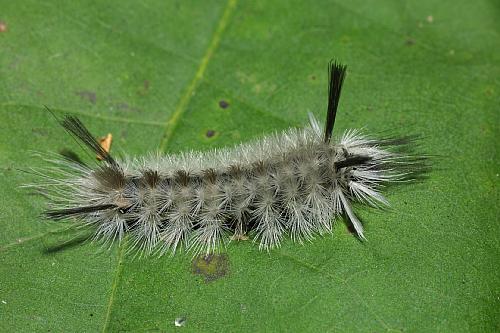
© 2002 Troy Bartlett
Pale Tussock Moth Caterpillar, Halysidota tessellaris
http://troyb.com/photo/gallery/00007443.htm
xxxxxxxxxxxxxxxxxxxxxxxxxxxxx
Great collection of pictures :
http://troyb.com/photo/gallery/section47.htm
xxxxxxxxxxxxxxxxxxxxxxxxxxxxx
Nuisance bugs of Laikipia (Kenya)
by Truman Young
Hairy caterpillars are the larvae of several species of tiger moths. They all look softly hairy, like a cashmere sweater. Unfortunately, many of these hairs are sharp, brittle, and irritant. Even a casual touch (I am sure the caterpillar would disagree) can result in dozens of hairs penetrating the skin. Not actually dangerous, but I have seen a bad reaction to them. When they are about, check your bedding, towels, clothes and shoes before use.
In some years, the all-black ones invade homes. The year 2001 will be remembered in our Segera house as the year of the hairy caterpillars. [Mpala was largely exempt, perhaps because there are no gardens around the buildings.] In the bush, one finds a pretty black and orange striped species, or one that is all black except the orange head. But the one that invades homes is entirely black. I think they are attracted to irrigated gardens.
On one memorable evening, I removed 40 of these little devils from our house. A few days later, I awoke to find one crawling on my pillow, inches from my face. Over a six-week period, I had a dozen "hits" and literally hundreds of hairs implanted. The ones we couldn't remove just worked their way into our flesh, and disappeared, often leaving a mean itch. However, one did fester and cause my finger to swell up considerably. I shook three hairy caterpillars out of my son's shoe this morning.
A nasty story: Keith Lindsay, a friend of ours, was doing his doctoral work in Amboseli back in the early 1980s. One evening while he was sleeping, one if these caterpillars dropped on his eyelid. His friends spent a long time gently tweezing out as many of the hairs as they could find, but the hairs are very brittle and many had broken off at skin level. His eyelid itched a bit, but he seemed OK. A few days later, he began to feel a different kind of itching in his eye. It felt like something was scratching his eyeball. The remaining hairs had worked their way down through the eyelid, and were now coming out the inner side! So now the job was to periodically peel the eyelid back, and tweeze these hairs out as they appeared. This is a true story.
http://tpyoung.ucdavis.edu/NuisanceBugs.htm
xxxxxxxxxxxxxxxxxxxxxxxxxxxxx
You burrowed into my heart like a hairy caterpillar,
I couldn't t stop you, I've got no insect killer
But hairy caterpillars become butterflies
Now I've those in my stomach when you are nearby!!
I LOVE YOU !!
Written by Maria Knight
http://www.lovelandia.com/archive/016863.html
xxxxxxxxxxxxxxxxxxxxxxxxxxxxx
Certain moth caterpillars are covered in hairs so that they look soft and furry, they are common worldwide, but only the South American species are really noxious. Children may find these miniature moving teddies attractive and wish to pick them up. When a child picks up such a caterpillar, falls on one, brushes against one or one gets inside the clothing; the "hairs"
penetrate the skin and cause pain and irritation.
http://www.travellingwithchildren.co.uk/m_health/9_4.htm#Hairy%20Caterpillars
xxxxxxxxxxxxxxxxxxxxxxxxxxxxx
Have a look at the beautiful -- and exciting! -- photographs on the web site given below. These photos are copyrighted, please do not take them for your own website.
The one on the first link most closely resembles those unidentified black hairy caterpillars which visit our Kenyan homes during those hot dry months :
http://www.javajane.co.uk/Hairy/slides/fox_moth.html
And a whole lot more are here :
http://www.javajane.co.uk/Hairy/index.html
*****************************
Worldwide use
Caterpillars, a worldwide KIGO
*****************************
Things found on the way
*****************************
HAIKU
hairy caterpillar --
five fingers stretch out to touch
that black fleece
Isabelle Prondzynski
xxxxxxxxxxxxxxxxxxxxxxxxxxxxx
Short summer night.
A dewdrop
On the back of a hairy caterpillar.
Buson Yosa (1716 ~ 1783)
http://www.big.or.jp/~loupe/links/ehisto/ebuson.shtml
xxxxxxxxxxxxxxxxxxxxxxxxxxxxx
that one time
my heart so merciless
I burned a hairy caterpillar
Masajo Suzuki
http://www.millikin.edu/haiku/courses/globalSpring2005/HaikuUnitPlan/appendix04.html
xxxxxxxxxxxxxxxxxxxxxxxxxxxxx
Would that I could learn. . .
From hairy caterpillar
To colored butterfly.
http://media.wiley.com/product_data/excerpt/9X/07879692/078796929X.pdf
*****************************
Related words
***** Caterpillars, a worldwide KIGO
*****************************
THE KENYA SAIJIKI
Please send your contributions to
Gabi Greve / Isabelle Prondzynski
worldkigo .....
Back to the WHC Worldkigo Index
Subscribe to:
Posts (Atom)


 Posts
Posts


