4/21/2005

Dust

[ . BACK to TOP . ]
:::::::::::::::::::::::::::::::::::::::::::::::::::::::::::::::::::::::::::::::::::::::::::::::::::::

Dust (Swahili : tifutifu)

***** Location: Kenya
***** Season: Cool dry season, hot dry season
***** Category: Heaven


*****************************
Explanation

The dust of the two dry seasons in Kenya is the counterpart of the mud of the rainy seasons. In both cases, it is the state of soil corresponding to the season.


Maasai cattle stirring up the dust on the football field

Kenyan dust mostly consists of soil particles. As the dry season progresses, the soil dries out, and its particles are blown here and there. Dust fills the air, it clings to clothes and hair, and it causes the coughs and colds of the dry season. Any shower is welcome, as it lays the dust... at least for a while.

Householders and their domestic staff sweep the compounds every day, to keep the dust under control. Cars are washed every day to rinse off the dust. Every hairwash leaves a basin of brown water.

The trademark of the Kenya Safari Rally seems to be pictures of race cars, each followed by a swirl of dust.

Text and photo : © Isabelle Prondzynski

:::::::::::::::::::::::::::::::::::::::::::::::::::::::::::::::::::::::::::::::::::::::::::::::::::


East African Safari Rally

© PHOTO www.eastafricansafarirally.com


:::::::::::::::::::::::::::::::::::::::::::::::::::::::::::::::::::::::::::::::::::::::::::::::::::

 CLICK for more photos !

*****************************
Worldwide use

Japan

spring dust, shunjin 春塵 (しゅんじん)
haru no chiri 春の塵(はるのちり)
harubokori 春埃(はるぼこり)

sand storm, sajin arashi 砂じんあらし(さじんあらし)
suna arashi砂あらし(すなあらし)
Yellow Sand, koosa 黄砂 coming from the deserts of China all the way to Japan


春塵や東京はわが死にどころ 
shunjin ya Tookyoo wa waga shinidokoro  

spring dust -
Tokyo is the place
of my death


Suzuki Masajo 鈴木真砂女
Tr. Gabi Greve


Takano Sujuu (Takano Suju)and his
Spring Dust Haiku


 春塵の鏡はうつす人もなく      
山口青邨

 釈迦の掌の生命線に春ぼこり   
吉水就子


.................................................................................


塵の身のちりより軽き小てふ哉
chiri no mi no chiri yori karuki kochoo kana


a body of dust
lighter than dust...
little butterfly

Kobayashi Issa
Tr. David Lanoue


:::::::::::::::::::::::::::::::::::::::::::::::::::::::::::::::::::::::::::::::::::::::::::::::::::::

Yemen

dust clouds
kigo for summer

Especially during summer, when loads of dust are in the air, it is rather uncomfortable and many Tihamis suffer from infected eyes.

dust clouds
up to the Highlands
burning eyes


Heike Gewi, Yemen, 2009

YEMEN SAIJIKI


*****************************
Things found on the way


*****************************
HAIKU


dusty morning --
four sparrows splash
in car wash water


(8th place, May 2007 Shiki Kukai)
http://www.haikuworld.org/kukai/archive.may2007.html


drought in the city --
even the bird bath
full of dust


Bird bath of All Saints' Cathedral Nairobi, full of dust
Photo © Isabelle Prondzynski

dusty wind --
a street trader selling
mugs without handles

dusty matatu --
people breathing inside
to edge it forward

~ Isabelle Prondzynski

:::::::::::::::::::::::::::::::::::::::::::::::::::::::::::::::::::::::::::::::::::::::::::::::::::

a flea crawling
on top of my book --
our dusty classroom


~ Timothy Wambugu


my sister
dusting her open shoes --
Saturday date


~ Catherine Maina


father dusting
his bible and humming a hymn --
Sunday morning


~ Gladys Naomi


dust
on the grass --
sports day


~ Sebastian Kimey


Dusty football practice
Photo © Isabelle Prondzynski


on the dusty road --
a street child limps
from jigger bites

~ Simon Magak


grey donkey --
rocking in the dust
to remove fleas


~ Elkana Mogaka


flea swatting
on the mattress --
dusty bedroom


~ Anne Wairimu


tall giraffe
along a dusty road --
tourist drive


~ Elungata Barrack


colonial bridge
crossing pedestrians over the
dusty railway station


~ Gideon Gichamba


hotter days
dusty environment
sick throats


~ Annastacia Muthoni


my shoes,
after arriving at school --
very dusty


~ Anne Wairimu


Dusty footpath
Photo © Isabelle Prondzynski


oh rain come
dust everywhere we go or sit
catching flu


~ Dorine Atieno


black shoes
turn brown --
dust all over

~ Mary Sharon Kaleche


the wind blows
carrying papers and soil --
it's dusty


~ Stephen Sigo


very dry --
cattle running across the field
leaving dust behind


~ Rhodah


brown sweat drops --
hawkers rest under the
dusty acacia tree

~ Hussein Hadji


dust --
white shoes
turn brown


~ Joan


a hot calm day
cattle walking on the path
brown dust behind


~ Angeline


after the rally
dusty cars
on the ramp

~ Sebastian


happy winners
on the dusty cars
pouring champagne


~ Hussein Hadji


a lorry passes
along the road --
dusty air to breathe


~ Opondo Mourice


dusty shoes --
wind blows across
sports ground


~ Khadijah


on a dusty road
rally cars speed up
dust rises


~ Kamau


papers fly
dust fills my eyes
wind blows

~ Yammame


vehicle move
along murram roads
dust all over


~ Fred Okido


dusty shoes --
students rest
under a mango tree


~ Titus

xxxxxxxxxxxxxxxxxxxxxxxxxxxxxxxxxx


St Patrick’s Outing, April 2007

April dust --
handkerchief covered with mucus
cursing the month


~ Dorine Atieno (Peacock)
(6th place in St Patrick’s Outing, April 2007)


April wind --
itinerant traders
with dust on their goods


~ Teresiah Wanjiku (Bamboocha)
(9th place in St Patrick’s Outing, April 2007)


April sun --
sweat running down my
dusty face


~ Sarah Adero (Bamboocha)
(11th place in St Patrick’s Outing, April 2007)


April dust --
ants struggling to scuttle
through the dusty sand


~ John Mwangi (Bamboocha)
(12th place in St Patrick’s Outing, April 2007)

xxxxxxxxxxxxxxxxxxxxxxxxxxxxxxxxxx


a dusty road between
two majestic rocky walls --
Hell's Gate

car after car
blowing dust into our faces --
the constant clatter of shoes

a dead wasp resting
on the dusty window pane --
no way through glass

~ Patrick Wafula


cloudy Saturday --
children play along
the dusty road


~ Nechesa Anne


:::::::::::::::::::::::::::::::::::::::::::::::::::::::::::::::::::::::::::::::::::::::::::::::::::::


wash me-
the dusty windscreen reads at
at the parking bay

scorching sun--
the little pond dries up
day by day


Hussein Haji
January 2011


:::::::::::::::::::::::::::::::::::::::::::::::::::::::::::::::::::::::::::::::::::::::::::::::::::::


stinky dustbin-
houseflies hover over
mango peels


Andrew Otinga
January 2011


:::::::::::::::::::::::::::::::::::::::::::::::::::::::::::::::::::::::::::::::::::::::::::::::::::::


dusty street--
a pregnant goat feeds
on mango peels


Patrick Wafula
January 2011


:::::::::::::::::::::::::::::::::::::::::::::::::::::::::::::::::::::::::::::::::::::::::::::::::::::


swirling dust--
coats clean basin water
in the sun

dusty car panes--
the back writings are clear
wash me

swirling dust--
take nylon papers
deep the sky


Barrack Elung'ata
January 2011

:::::::::::::::::::::::::::::::::::::::::::::::::::::::::::::::::::::::::::::::::::::::::::::::::::::

chilly morning --
a brown donkey pulls
a dusty cart


Synaidah Kalahi


*****************************
Related words

***** Mud (Swahili : matope)


***** Kenya Safari Rally

***** Mud (Swahili : matope)


:::::::::::::::::::::::::::::::::::::::::::::::::::::::::::::::::::::::::::::::::::::::::::::::::::::


[ . BACK to WORLDKIGO . TOP . ]
::::::::::::::::::::::::::::::::::::::::::::::::::::::::::::::::::::::::::::::::::::::::::::::::::::: 

4/05/2005

Dewali

nnnnnnnnnnnn TOP nnnnnnnnnnnnn

Dewali

***** Location: Kenya
***** Season: Changes with the Season
***** Category: Observance


*****************************
Explanation

Divali is an Indian festival and now celebrated in all Indian and Hindu communities worldwide.

Diwali (the Kenya spelling) is celebrated in Kenya, mostly by the Indian population. In Kenya, it is generally associated by all and sundry with fire crackers, which are popped all around the country for a few days, as soon as darkness falls.If one mixes a bit more in Indian circles, one might be lucky enough to be given the special sweets (only available for Diwali) and to see the rangoli (coloured patterns made with finely ground chalk) in the temples. There are special concerts (Bollywood music and more!) and no doubt plenty of other activities, including much socialising.

Isabelle Prondzynski

xxxxxxxxxxxxxxxxxxxxxxxxxxxxxxxxxxxxxxxxxxxx


http://hinduism.about.com/library/graphics/lakshmi/wb78.jpg

*****************************
Worldwide use

India

Divali in India

*****************************
Things found on the way


*****************************
HAIKU


To be added.
xxxxxxxxxxxxxxxxxxxxxxxxxxxxx


*****************************
Related words

*****

*****************************

Editor: Isabelle Prondzynski

********************
Please send your contributions to
Gabi Greve/Isabelle Prondzynski

worldkigo .....

To the WHC Worldkigo Index
http://worldkigodatabase.blogspot.com/

Demolitions

nnnnnnnnnnnn TOP nnnnnnnnnnnnn

Demolitions in Patanisho

***** Location: Kayole, Nairobi (Kenya)
***** Season: Non-seasonal Haiku Topic
***** Category: Humanity


*****************************
Explanation

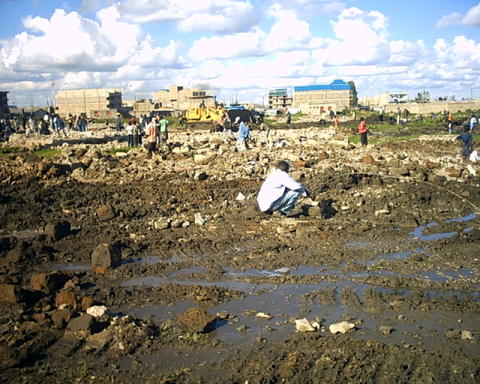
In the night from 23 to 24 November 2006, the houses that bordered Jacaranda and Patanisho in Kayole were demolished, leaving hundreds of families homeless.

The land where these demolitions took place, has an interesting and chequered history. Taken from the local people by the British colonialists; sold by them before Independence (1963) to a group of Kiambu Dandora Farmers; one smaller section hived off and allocated to a prominent businessman politician; fought over by the farmers, the politician’s widow and a further politician from a different party; finally grabbed by a gang of youths and sold by them to innocent and rather less innocent outsiders -- there is sufficient stuff here for a full-length novel.

The politician’s widow eventually went to court and won her case. She started to develop the empty section of her land, but wanted access also to those other parts which had been occupied and sold off by the gang. After giving the residents notice four times unsuccessfully, she asked for help from the forces of law and order.

It is thus that the police and the bulldozers arrived in the night of 23 October 2006, ordering people leave the houses immediately, and starting to demolish the structures on the land in question. The gangs turned up very soon, and they were armed. A fierce battle ensued, and one of the policemen was shot and severely injured and taken to Kenyatta National Hospital.


Photo : Patrick Wafula

The people who lost their houses include some of the young gang members and grabbers, and some of the cheated buyers, who had purchased the land innocently (but had failed to insist on title deeds). All of them suffered in the demolitions, particularly as a result of the violence caused by the gang members, and some of them suffered severe financial loss.

At the end of the story, the rule of law has prevailed, but at a cost. If it makes their business more difficult for the gang members and land grabbers, some of the price may have been worth paying... However, as the haibun and haiku below will show, innocent people suffered, and those who saw them were moved to write down their observations and their words of sympathy.

Isabelle Prondzynski.

xxxxxxxxxxxxxxxxxxxxxxxxxxxxx

HAIBUN

It was on Thursday night and all was quiet. The frogs were singing their last chorus and gave humanity a chance to enjoy the rest of the night. Suddenly after midnight :

bullets crack -
the night withers
dreams disappear


Only the families that were being affected knew what was happening. For the rest of us :

fear of unknown
with soundless prayers
lay trembling


As I woke up in the morning, hoping to find the fruits of the more than four hours of gunshot, I was amazed just to see men in blue (the police) and two bulldozers. As I watched the act of the machine,

the fork went up
the houses come down
tears for breakfast


This reminded me of fifteens years ago, when living in Kangemi,

fifteen years
the ghost still alive
making desolate


when our homes were demolished. The unfolding of the painful experience made tears to flow down my eyes and so were those of everybody else around me who imagined what was about to become a painful experience.

tears water --
the muddy green land
curses all over


Kiambu is the famous name given to the particular area that was demolished (it is very different from Kiambu district). This took place after one tycoon’s widow won the case over the land dispute and now she wants to put up housing estates. Young men and women from Soweto slums had occupied some of the land.

As I write this report, the former occupants have being told to clear up, before all that is within the zone is declared as belonging to the private developer. I hope I have shed some light on the whole issue. On behalf of our parents, brothers and sisters that were affected I say thanks for your concern and prayers.

© Antony Njoroge, 2006

*****************************
Worldwide use


*****************************
Things found on the way


*****************************
HAIKU


pick-ups full of
house-holds leave Patanisho...
new refugees

bulldozers pile
rubble onto lorries...
desperate screams

mothers and children
drenched in downpour...
houses gone

fires in the open
as mothers prepare supper...
cries of hungry children

ruthless policemen
shoot in the air...
fleeing residents

on the roadside,
refugees sit with luggage...
helplessness


Photo : Patrick Wafula

a woman screams,
trying to stop the bulldozer...
police drag her away


Patrick Wafula

xxxxxxxxxxxxxxxxxxxxxxxxxxxxx

tearful eyes ..
houses demolished
leaving many homeless


Duncan (Butterfly Haiku Club)

xxxxxxxxxxxxxxxxxxxxxxxxxxxxx

houses and property
destroyed by bulldozers...
houseless tenants


Jasper Ratemo (Butterfly Haiku Club)

xxxxxxxxxxxxxxxxxxxxxxxxxxxxx

people crying
their building is brought down
people crowded

building down
as men hit the walls
stones everywhere


Adelaide Luvandale

*****************************
Related words

***** Jamhuri Day

*****************************
THE KENYA SAIJIKI
Please send your contributions to
Gabi Greve / Isabelle Prondzynski
worldkigo .....

Back to the Worldkigo Index

4/01/2005

Day of the African Child

nnnnnnnnnnnn TOP nnnnnnnnnnnnn

Day of the African Child

***** Location: Kenya, Africa, worldwide
***** Season: Cool dry season
***** Category: Observances


*****************************
Explanation

The Day of the African Child (16 June)

This is a noticeable observance in Kenya. It is preceded by a build-up of several months. During this time, children practise the performances they will put on that day, adults prepare petitions or speeches, and fund-raising walks and other preparatory activities take place. Even this lead-up is well reported, as events usually happens in the city centre of Nairobi, where they draw attention to the cause of the African Child, who is being and will be celebrated.

The Day itself will have newspaper articles and TV reports on the celebrations and the speeches, as well as the many improvements still needed in the life of the African child -- education for all, an end to violence against children, water, food and sanitation for the health of children, as well as reflections on life in countries where war, kidnappings and child labour blight children’s lives.

Isabelle Prondzynski


http://www.eastandard.net/images/sato/hmpg170606.jpg

A girl sheds tears during the celebration to mark the Day of the African Child in Naivasha yesterday. Vice President Moody Awori was the chief guest.
Picture by Antony Kilonzi

xxxxxxxxxxxxxxxxxxxxxxxxxxxxx

Harm children no more: Why Africa must rediscover Soweto
By Yvonne Chaka Chaka

UNICEF Goodwill Ambassador for Eastern and Southern and Africa Yvonne Chaka Chaka, a South African musician and businesswoman, offers reflections and a call to action on the Day of the African Child


http://www.unicef.org/infobycountry/images/ibc_southafrica_dayafricanc.jpg

For those old enough to remember, Soweto symbolizes courage. In 1976 during apartheid, young people my age, (I was 11), angry at being taught Afrikaans – seen as the language of oppression – decided to protest. On 16 June, 10,000 of them, mostly school children, took to Soweto’s streets in peaceful demonstrations.

The authorities responded with force. Armed police lobbed tear gas into the crowd and the students retaliated with rocks. When the mayhem was over, 152 children lay dead. The protests continued into 1977, by which time over 700 young lives had been lost. On 26 June that year, the government revoked the teaching of Afrikaans in all-black schools, a triumph for the anti-apartheid movement.

Fifteen years later, in 1991, the Organization of African Unity immortalized the Soweto Uprising by declaring 16 June the Day of the African Child. This declaration marked an official recognition of the children’s contributions to the struggle against apartheid.

This year’s Day of the African Child has as its theme, ‘Stop Violence against Children.’

Incidents of young girls, especially orphans, being raped or molested are reported every day in the media. The perpetrators – often fathers, uncles or neighbours – go unpunished because law-enforcement officers regard these crimes as domestic matters. For these children, though, the family – that sanctuary of peace and safety – has become a haven of impunity and a source of horror.

Where institutions do provide safety for abused children exist, they are woefully inadequate or poorly funded. The violence that is prevalent in the home, in fact, may simply be transferred to the institution.

We need an iron-clad resolve from the highest levels of political leadership. When they memorialized 16 June in 1991, our presidents were in effect saying, “Never again will Africa’s children be violated, abused and mowed down in the manner of the Soweto massacre.” That resolve needs to be rediscovered. Ceremony alone is simply not good enough.

Violence begets violence.
Only strong, robust action against the cycle of violence will fit the tribute that Soweto’s young heroes truly deserve.

http://www.unicef.org/infobycountry/southafrica_34550.html

xxxxxxxxxxxxxxxxxxxxxxxxxxxxx

Celebrations in the Pumwani slums, Nairobi

All over the continent, the Day of the African Child was celebrated yesterday, 16 June 2006, in memory of the peaceful demonstration of children in Soweto, South Africa, 30 years ago.

By Morten Bonde Pedersen

In another African metropol, Nairobi, St. John’s Community Centre this week had arranged for celebrations throughout the week. The event peaked on the 16th when children from entire Pumwani were invited for a day of theater, music, performance and speeches.

Parallel to the ongoing events children from the slums took part in various activities, e.g. having their hair done and their nails and faces painted by cosmetology students from Nairobi who had all volunteered for the event.


http://ms.inforce.dk/graphics/Kenya/Pictures/DayoftheAfricanChild3.jpg

http://www.ms.dk/sw39291.asp

xxxxxxxxxxxxxxxxxxxxxxxxxxxxx

The celebrations -- a schedule for 2003

UNICEF is a member of the National Steering Committee for the Day of the African Child. The Committee is chaired by the Children's Department and has a membership of about 20 NGOs. This year, the Department of Civil Registration joined the Committee because of the birth registration theme. In the week prior to Day of the African Child various activities have been planned that will include :

* 7th June - An NGO - 'Dagoretti 4 Kids'- holds an informal march and rally to protest child labour and substance abuse. The local civil registrar will talk about birth registration.

* 9th June - Week- long activities to mark the day will be launched by the Asst. Minister, Home Affairs, in Maraktwet District at a rally focusing on birth registration. Marakwet District has one of the lowest birth registration rates.

* From 10th June training of birth registration agents and social mobilization for the community-based system of civil registration at the locational level will begin in Marakwet and Keiyo districts. These activities are supported by UNICEF KCO as part of the vital statistics project.

* Between 10th and 11th June - Children's Department Launches the Guidelines on the care of orphans and other children made vulnerable by HIV/AIDS. The guidelines were developed by the Government in collaboration with NGO partners, the National Aids Control Programme and UNICEF.

* 11th June - ANPPCAN holds a public baraza (rally) in the Kibera slums to talk about child rights.

* 12 - 15 th June - The Girl Child Network and Plan Kenya will hold workshops for children on child rights in all the Districts where Plan has projects.

* 12 - 13th June - 'The Chambers of Justice', a human rights foundation holds an exhibition at the Kenyatta International Conference Centre on 'Investing in Children'. The significance of birth registration for investment in children will be highlighted. The exhibition will kick off the petitioning process for the 'Cancel-Debts- for-the-Child' campaign. The campaign is spearheaded by the Chambers and has the support of 20 NGOs and several Government Departments. UNICEF is one of the supporters of the campaign, which was launched on April 6, 2003 by the Minister for Home Affairs.

* 14th June - A pleasure/educational train ride for children to Naivasha organized by the NGO- Juhudi Children club.

* 16th June - Public Rally in Nairobi on birth registration. Proposed venue - Starehe Boys Centre. The Minister for Home Affairs, Hon. Moody Awori, will officiate. The UNICEF Kenya Representative will speak at the rally. A supplement on birth registration will be placed in one of the country’s leading dailies.
This will be sponsored by JICA (Japan International Co-operation Agency)
www.unicef.org/newsline/2003/dac2003inesaro.doc


*****************************
Worldwide use


*****************************
Things found on the way


*****************************
HAIKU


chattering school girls --
a child leads a blind man
jangling his shillings

Isabelle Prondzynski

xxxxxxxxxxxxxxxxxxxxxxxxxxxxx


*****************************
Related words

***** Missing Children’s Day


*****************************
THE KENYA SAIJIKI
Please send your contributions to
Gabi Greve / Isabelle Prondzynski
worldkigo .....

Back to the Worldkigo Index

Easter Bonnet

[ . BACK to TOP . ]

:::::::::::::::::::::::::::::::::::::::::::::::::::::::::::::::::::::::::::::::::::::::::::::::::::::

Easter Bonnet

***** Location: Trinidad and Tobago
***** Season: Dry season
.............. Spring in Europa
***** Category:


*****************************
Explanation

The Easter bonnet tradition, derives from olden times, when people dressed up every Sunday to go to church. Ladies purchased new and elaborate designs for particular church services, and in the case of Easter, taking the opportunity of the end of Lent to buy luxury items.
Some believe that wearing three new items of clothing at Easter brings good luck.

Easter bonnets are generally round and filled with ribbons, flowers and leaves.

Another thought suggests that the Easter bonnet derives from the circlet of flowers worn at Spring rites even before the tradition of Easter.

The circular shape of the Easter bonnet symbolizes the circular shape of the sun and the full-circle return of the beginning of Spring

Today Easter bonnets are as elaborate or simple as the wearer desires and they are worn to church at Easter and or at Easter Bonnet Parades. The tradition embraces both adults and children.

Gillena Cox , Republic of Trinidad and Tobago

:::::::::::::::::::::::::::::::::::::::::::::::::::::::::::::::::::::::::::::::::::::::::::::::::::::


Click on the photo to see some more !

:::::::::::::::::::::::::::::::::::::::::::::::::::::::::::::::::::::::::::::::::::::::::::::::::::::


http://en.wikipedia.org/wiki/Easter_bonnet


*****************************
Worldwide use

Ireland

During my childhood in Ireland, Easter bonnets were quite the fashion -- every woman feeling that she wanted to buy a new hat in time for the Easter Sunday Mass or Church Service. Those were, of course, the days when women were expected to cover their heads in church -- and men to uncover them! I cannot remember any particular shape being preferred for the bonnets -- but I do remember that hats were sometimes not the only new fashion items bought in time for Easter Sunday...

This custom seems to have disappeared now -- perhaps because hats are no longer worn by either sex in church, perhaps because Ireland has become wealthy and people just buy the new clothes they want at any time of the year. But the word and the memories are still there...

Isabelle Prondzynski

*****************************
Things found on the way


Lavinia Dobler, author of Customs and Holidays Around the World, says Easter was once known as the "Sunday of Joy." In the USA after the Civil War, mothers and daughters began wearing colorful flowered hats and elaborate corsages as part of the celebration.

LINKS

http://www.villagehatshop.com/easter_bonnet_tradition.html

http://www.chevroncars.com/learn/fun-games/easter-bonnets

http://www.lcg.org/cgi-bin/tw/commentary/tw-comm.cgi?category=Commentary\ 1&item=1144735276


*****************************
HAIKU


bright day
the lip-stick smile of a child
in her Easter bonnet


poui blossoms
and Easter bonnet parades
season of Easter


© gillena cox 2007

xxxxxxxxxxxxxxxxxxxxxxxxxxxxx

*****************************
Related words

***** Easter

*****************************
THE KENYA SAIJIKI
Please send your contributions to
Gabi Greve / Isabelle Prondzynski
worldkigo .....

Back to the Worldkigo Index