6/18/2005

Frangipani, Plumeria

[ . BACK to Worldkigo TOP . ]
:::::::::::::::::::::::::::::::::::::::::::::::::::::::::::::::::::::::::::::::::::::::::::::::::::::

Frangipani, Plumeria

***** Location: Kenya, India, Australia and other tropical countries

***** Season: Hot dry season, cool dry season
............. Summer in Australia and India

***** Category: Plant


*****************************
Explanation

Frangipani trees are planted in Nairobi here and there, in public parks and large gardens, usually just one or two, as they need space and attract plenty of attention. In Mombasa and at the Indian Ocean coast, around the famous beach resorts, they are planted together with bougainvillea and poinsettia and provide a special attraction for tourists.

This small tree has a striking appearance, with long bare elephantine branches, a small tuft of leaves at the end of each branch, the tip studded with scented flowers.

Kenya has several bulbs, shrubs and trees with a delicious perfume... but of all these, the frangipani tree and its blossom also have the most beautiful appearance.

The frangipani tree is much beloved by the Hindu community of Kenya, who present its flowers as offerings in their temples. One can see piles of the flowers in Mombasa temples in the morning, brought in by the faithful.

Some of the airlines display just one or two fresh frangipani flowers in their WCs en route from Kenya to Europe -- a natural perfume which quite fills the cell with its fragrance.

Isabelle Prondzynski

xxxxxxxxxxxxxxxxxxxxxxxxxxxxx


© http://www.xcalak.info/visit/uk/plants-uk.shtml

xxxxxxxxxxxxxxxxxxxxxxxxxxxxx

Frangipani, Temple Tree
Plumeria spp. Family : Apocinaceae

This is a familiar shrub, almost a small tree, having a characteristic appearance, with rather thick, smooth, green twigs which branch regularly and ooze large quantities of latex if damaged. It is often planted near temples and in cemeteries in India and South East Asia.

The white variety (P. alba) originates from the West Indies and is named after the Frenchman Plumier, who was a pioneer of West Indian botany. The pink-flowered Frangipani (P. rubra) comes from Central America and now has a wide range of allied colours.

It is suggested that the name Frangipani originates from the French frangipanier, meaning coagulated milk; but a more attractive hypothesis refers to a perfume developed from its flowers in the 12th century by an Italian nobleman named Frangipani.

John Karmali, The Beautiful Plants of Kenya, Nairobi 1993.

xxxxxxxxxxxxxxxxxxxxxxxxxxxxx
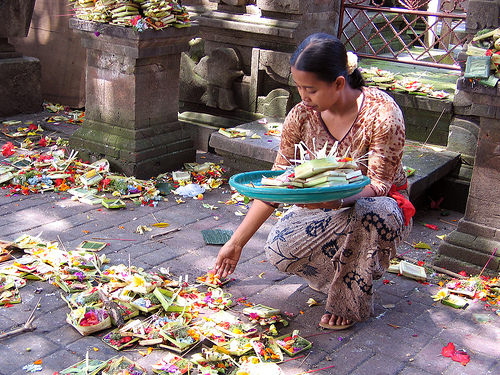

Balinese girl in a Hindu Temple, Ubud, Bali,
Indonesia, August 2005
© http://www.flickr.com/photos/pape/128564255/in/set-72057594063093676/

xxxxxxxxxxxxxxxxxxxxxxxxxxxxx

Plumeria rubra, Frangipani

A large, commonly seen succulent shrub that reaches 5 m in height. It is much favoured in the tropics, growing at altitudes from sea level to 2,000 m.

Bark : Grey, smooth, with prominent leaf scars.
Branches : Thick, forking, exuding a milky sap when wounded; sap very poisonous.
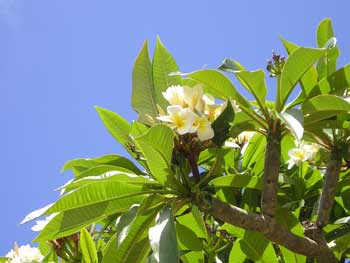
Leaves : Large; dark; leathery; lanceolate; in terminal bunches at the end of branches; tapering to base and apex; 20-22 cm across; prominent veins; regular, usually shed during the dry season, when flowers appear.

Flowers : White, yellowish, pink or reddish purple; 5 petals, overlapping at the centre and curled at the edges; 6 cm across; scented; in terminal bunches.
Fruit : Paired capsules up to 25 cm in length.

Uses : According to legend a 12th-century Italian called Frangipani combined certain volatile oils, including the oil of these flowers, to create an exquisite perfume, which made his name and fortune. Today the plant, to which many names and stories are attached, is widely cultivated throughout the tropics. In Asia, it is often grown near Buddhist temples, where it is known as the ‘pagoda tree’, and the flowers are sometimes called ‘temple flowers’. It is also frequently planted near graves, especially those of Muslims and Buddhists. The latex in the branches is poisonous, though apparently useful in the treatment of skin cuts and inflammation.

Najma Dharani, Field Guide to common Trees and Shrubs of East Africa, Cape Town 2002.

xxxxxxxxxxxxxxxxxxxxxxxxxxxxx

© http://www.frangipani-aroma.com.au/Japanese/personalityjp.htm

*****************************
Worldwide use

India

In India, the name of frangipani is "champa" or "chafa", in Telugu "Deva ganneru" (divine nerium), in Manipuri "Khagi Layhaaw"

Fragrant frangipani
THE FRANGIPANI is a popular tropical plant, growing to smallish tree-like proportions. As it is propagated both by way of seed and cutting, the plant is found almost everywhere in India, the East and the Far East.

The beauty of the flower, along with its fine wafting perfume, has made the flower a popular offering in Buddhist temples all over the East.

Of the Apocynaeceae family, its botanical name is Plumeria, after the French botanist Charles Plumer, who first found the plants in the Caribbean in the 17th Century.

The plant goes by various unusual names — `Dead Man's Fingers' in Australia, `Jasmin de Cayenne' in Brazil and `Pagoda' or `Temple Flower' in India. Frangipani came from `frangipanier' or coagulated milk, so called by the French settlers in the Caribbean in the 17th Century.

The P. Rubra is the most common of Plumerias and has given rise to many cultivars. Most common is the white with yellow centres, while other Rubras come in shades of red, pink, yellow and a mix of these colours.

The plants also do well in pots, needing strong sun and enough water. The leaves drop and flowering lessens, till the plant gathers strength to start blooming profusely again. A single frangipani tree in bloom will scent the air for quite a distance in the evenings, making it a beautiful acquisition to any home. The bunches of flowers make the tree attractive.

© RUPA GOPAL
http://www.hindu.com/mp/2004/06/03/stories/2004060300260300.htm


- - - - - and this blossom

Champa, Joy Perfume Tree - Magnolia champaca

The most interesting part of the tree are its flowers which are not very showy with few narrow yellowish white petals, but have an extremely heady fragrance. This fragrance has made Champa flowers very popular and they have been part of the culture in India from time immemorial. They are used in religeous offering in various parts of India. On a warm humid night, the scents can easily be enjoyed several hundred feet away. Champa flowers are used to make the world's most expensive perfume 'Joy' in America.
source : www.flowersofindia.net

between wedding
and the blooming of champa . . .
her tears


- Shared by Sandip Chauhan -
Haiku Culture Magazine, 2013


*****************************
Things found on the way


*****************************
HAIKU


Uhuru Park --
sweet scented sunshine under
the frangipani


Isabelle Prondzynski, Kenya


:::::::::::::::::::::::::::::::::::::::::::::::::::::::::::::::::::::::::::::::::::::::::::::::::::::


cloudy sky --
yellow frangipanni blooms
in green leaves


Patrick Wafula, Kenya


:::::::::::::::::::::::::::::::::::::::::::::::::::::::::::::::::::::::::::::::::::::::::::::::::::::


© becky blair. yellowhouseart
http://www.yellowhouseart.com/photos/work_details.asp?urn=1642


:::::::::::::::::::::::::::::::::::::::::::::::::::::::::::::::::::::::::::::::::::::::::::::::::::::
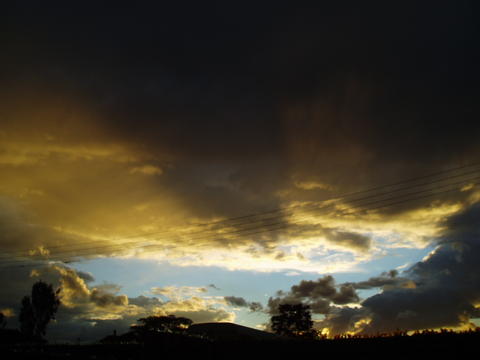

frangipani scent . . .
somewhere in my mind, the seed
of a haiku

Richard Kay, Australia


xxxxxxxxxxxxxxxxxxxxxxxxxxxxx


plumeria blooms
butterflies sparrows etch
my vast solitude ~


Narayanan Raghunathan

xxxxxxxxxxxxxxxxxxxxxxxxxxxxx


On my slow walk home
Saw a frangipani fall -
So I picked it up


Wing
http://blog.wingdingo.com/2007/01/03/frangipani/

:::::::::::::::::::::::::::::::::::::::::::::::::::::::::::::::::::::::::::::::::::::::::::::::::::::


beach sunset
a frangipani trodden
into wet sand

Sharon Trevelyan Dean
http://users.mullum.com.au/jbird/dreaming/ozku-beach.html


:::::::::::::::::::::::::::::::::::::::::::::::::::::::::::::::::::::::::::::::::::::::::::::::::::::


Some Haiku by Angelee Deodhar, India

frangipani blooms
softening iron balustrade
of the stone terrace

http://www.tempslibres.org/sites/ang/hku/ang04.html


windswept -
into the upside down umbrella
frangipani blossoms

http://www.geocities.co.jp/Bookend-Christie/5203/2004.html


end of summer
the first whisper of rain
on the frangipani

http://summerhaiku.blogspot.com/2006_07_01_summerhaiku_archive.html

xxxxxxxxxxxxxxxxxxxxxxxxxxxxx


starless night
frangipani blossoms
litter the lawn


Sue Mill
Copyright 2003 Simply Haiku
http://www.poetrylives.com/SimplyHaiku/SHv1n6/Sue_Mill.html


::::::::::::::::::::::::::::::::::::::::::::::::::::::::::::::::::::::::::::::::::::::::::::::::::::: 

strewn, grounded
white frangipani flowers~
petals of autumn


- Shared by Mark Phillip Liston - Newcastle, Australia
Joys of Japan, 2012


*****************************
Related words

*****

::::::::::::::::::::::::::::::::::::::::::::::::::::::::::::::::::::::::::::::::::::::::::::::::::::: 

[ . BACK to WORLDKIGO  TOP . ]

:::::::::::::::::::::::::::::::::::::::::::::::::::::::::::::::::::::::::::::::::::::::::::::::::::::

6/15/2005

Form One Entrants

[ . BACK to Worldkigo TOP . ]
:::::::::::::::::::::::::::::::::::::::::::::::::::::::::::::::::::::::::::::::::::::::::::::::::::::

Form One entrants and monolisation

***** Location: Kenya
***** Season: Hot dry season
***** Category: Humanity


*****************************
Explanation

The Kenyan school year starts in January. New students entering Form One of secondary school (usually aged 14 or over), register in January and start classes at the beginning of February.

This is a very big step for a Kenyan student. Form One entry, in modern Kenya, functions as the equivalent of circumcision, i.e. entry into adulthood. People may or may not practice circumcision or other rites of passage -- either way, initial research has found that the transition between primary school and secondary school has come to resemble these older practices. This is expressed by massive parties (so-called “bashes”) held by the youth, largely without adult supervision, as well as by the short-term victimisation (so-called “monolisation”) of the new Form One students by their predecessors. Sometimes, things can go wrong (see article below).

The end of primary school is achieved by a national examination, the Kenya Certificate of Primary Education (KCPE). Only about 50 percent of students passing this examination find places in secondary schools -- the other 50 percent dropping out either because they have not achieved the necessary points for the limited number of places, or because they cannot raise the necessary fees.

While primary education (eight years, from age 6 to age 14 or over) is now free of charge in Kenya, secondary education is subsidised but fee-paying. Many bright students, who cannot find a scholarship or a sponsor, drop out at this stage, even though they might have had the points to enter a recognised secondary school.

Bahati High School, in Kayole, Nairobi, being run by volunteers, is able to provide education at low cost, and can therefore offer places to the children of the community without being selective as regards points. This school started the Bamboochas Haiku Poetry Club at the start of 2006. Now, one year later, is the first time that the Bamboochas have welcomed new Form One entrants.

This coincides with the exciting moment when the school is building a corrugated iron laboratory as its contribution to recognition as an exam centre for the Kenya Certificate of Secondary Education (KCSE) from the end of 2007.

Secondary school involves many changes for the new entrants. The style of the uniform changes (dresses are replaced by skirts, shorts by trousers, checked cloth is out while plain colours are in, both girls and boys wear ties), many new subjects appear (history, geography, the sciences), English becomes the language of instruction for all, and this may be the first time that the students meet classmates from other parts of the country, speaking a different mother tongue.

All the haiku collected below were written by the Form One entrants themselves -- brand new haijin. They convey the atmosphere so well -- please enjoy reading their work!


Bahati High School

Text and photo : © Isabelle Prondzynski

:::::::::::::::::::::::::::::::::::::::::::::::::::::::::::::::::::::::::::::::::::::::::::::::::::

School where boys have to be 'men'
Daily Nation, 15 February 2007
By: PATRICK MUTHURI and MUCHEMI WACHIRA

The excitement that comes with joining Form One was evident on the faces of the young students as they were guided by their parents through the gates of Kiriani Boys Secondary School in Meru South District last week. They were excited to be joining secondary school and many of the parents had toiled hard to meet the many expenses that come with sending children to high school.

The usual words of advise for the students to take their studies seriously could be heard as the parents bid their children goodbye and left them behind.

But 25 of the parents could not believe their eyes when three days later, their children arrived home, carrying all their belongings and a letter from the principal, Mr Ngaruthi Kithinji, saying they could not be allowed in the school because they were not circumcised. They were lost for words.

Even if they were to take their sons to be circumcised, it would take no less than a month for them to heal enough to resume studies. Meanwhile, other students would be going on with learning.

But Mr Kithinji said the presence of the uncircumcised boys in the school could lead to unrest. "There was a lot of screaming and disturbances when your son was discovered to be the way he is. Just like you cannot keep your elder son who is uncircumcised in the same room with your younger son, this also applies in the dorms," Mr Kithinji said. He told the parents of the affected children to have them circumcised in two weeks and take them back to school when they get well.

The parents are now appealing to the Government to intervene.

Trouble started on their first night in school. The older boys ordered the newcomers to strip naked so that they could be inspected. Those who were not circumcised spent the whole night going through all manner of torture and insults. Says one of the boys: "The first night was very bad. We were never given a chance to rest or sleep even after the long journey. They started shouting and asking us silly questions like are you a man or a woman?"

The following day, they reported the matter to the principal, who instead of assisting them, sent them home.

The Meru South district commissioner, Mr William Kiprono, ordered the immediate reinstatement of the students, saying it was wrong to take such a discriminative action. "Circumcision is a cultural thing not accepted in some societies. It's wrong to chase students from a public school because it is not government policy," said Mr Kiprono, while apologising to the students and their parents. "The bullies were the ones to be sent off and not the other way round," he said.

But even as Education minister George Saitoti was condemning the action by the headteacher, the students demonstrated in his support yesterday afternoon.
... //www.nationmedia.com/

*****************************
Worldwide use


*****************************
Things found on the way


*****************************
HAIKU


By Patrick Wafula
Patron of the Bamboocha Haiku Club, Bahati High School

The New Bamboochas, who number about 40, have been taking their first lesson in haiku this week. First, it was Form One West, then Form One East. On Ash Wednesday (21 February 2007), I spent the lunch hour with Form One West, giving them their first haiku lesson. It was a great joy and experience. We wrote the first haiku together as a class; the rest were written individually.

Form One East took their lesson three days later. The new haijin have been writing about the new school year and their experiences in Bahati High School. They are such a bundle of joy! Some of their experiences are hilarious, others are pitious, but each of these experiences are true.

Fasting and Prayer day (Wednesday 21/02/07)

The Form One West had their first prayer and fasting experience and they wrote about it in their very first haiku the next day :

Mr. Wafula
taking photos of
the new lab

in the school kitchen --
Sharon happily biting
a huge chapati

from the kitchen,
delicious scent of chapati --
a rumbling stomach

a student
giving a testimony...
hymns are sung

Mr. Wafula
praying for sponsorships...
moment of silence

Mr. Wafula
taking photos --
students praying


~ Class


Patrick Wafula Sensei with his camera
Photo (c) Isabelle Prondzynski


in the kitchen --
people eat chapati
revenging for Wed


~ Timothy Wambugu

(On Thursday, students were eating chapati to compensate for what they missed to eat the previous day during the fasting and prayer)


first year in Bahati
prayers and fasting --
my grumbling stomach


~ Josephat Mwangi

students making noise --
their cries as Mr. Macharia
beats them

students dozing
during History lesson --
the teacher's shouts


~ Steven Nzomo


a teacher with a sad face
going back to the staffroom...
what stupid students


~ Shadrack Masai Mwengi

in the sitting room --
we happily take breakfast
with my family

~ Mercy Karanin

Mr. Ogembo writing
on the blackboard --
students laughing

last lesson to lunch...
bored students wait to go
for lunch

students laugh
as Mr. Ogembo says gaii...
geography lesson

~ Samuel Ndung'u

Mr. Macharia in class...
students sleeping on the desk
and they get strokes

~ Gerald Kariuki

students rejoice
around the new laboratory --
praise for Isabelle

~ Caren Cheptoo

students laugh
and cheer up --
last lesson to break

~ Vivian Adhiambo

in class
Beatrice cries like a baby --
corporal punishment

~ Jonah Kamande


at the school kitchen
people carry plates and spoons --
chapati in hand

at home --
my brother happily runs
to me for a kiss

at the shop --
a long queue of people
waiting to buy goods

everybody quietly settled,
writing and reading stories --
library lesson

~ Anne Wairimu


Constructing the new laboratory
Photo (c) Patrick Wafula


NEW SCHOOL YEAR HAIKU (Form One East)

new different
school rules…
Discipline Prefects

smell of my
new school ID…
smell of sewage

~ Christine Minae

first time
to wear trousers…
my new uniform

in the school kitchen,
big transparent chapatis…
smell of food

~ Peter Mwangi

new school lab --
teacher lights the Bunsen burner,
for students doing experiments

many students
of different tribes --
Bahati High School

many rules to keep --
if you break one,
punishment

~ Dorothy Nthenya


first day
in Bahati High School --
different daily menu

meeting
and making new friends…
first day in Bahati

~ Brian Mwangi


school kitchen --
much tasteless
rice

first day in Bahati --
smell of new
textbooks

first time
to wear a tie --
Bahati High

~ Rose Mwikali


many tribes of students --
my first day in
Bahati High School

first time to
own school ID --
Bahati High school

first time
to meet Discipline Prefects …
Bahati High School

in the lab,
Rose holding a gas jar …
first Chemistry Lesson

~ Eunice Mwema


first time in school kitchen --
many students enjoying
different menu

first day in Bahati --
many new classrooms
with different arrangements

first day in Bahati --
students in the lab,
smell of chemicals

~ Truphosah .I. Osendi

many different subjects…
first time in Bahati
High School

many new students
confused like lost
sheep in a forest

greedy Form Four
students in the kitchen --
first day in High School

~ Michael Bwoga

confused like a maggot
in a demolished toilet --
first day in High School

~ Sheillah Shikawa

many tribes of students --
communication problems
between Luo, Kikuyu, Kamba and Luhya

~ Rhodah Ndindah

smell of my
new uniforms --
first day in Form One

first day
in High School --
meeting different tribes

in Bahati School,
talking nicely to students --
Discipline Prefects

seventh week
in Bahati School --
new lab built

first time
to carry student ID --
Bahati School

~ Maxiwell Omondi

black water
flowing down along Soweto --
smell of sewage

many new faces,
different languages --
first time at Bahati

many new
scaring subjects --
biology, geography

~ Catherine Wanjiku


hardworking teachers,
teaching all the subjects --
students nodding

~ Jane Mumbua

students struggle
to keep school rules --
speaking English all the time


~ Nelius Muthoni

time keeper
ringing the bell --
lesson after lesson

~ Alice Wambui

ndengu and chapati,
ndengu and chapati for lunch --
rumble of my stomach

first time
to see black water --
sewage river

~ Patrick

time keeper
ringing the bell --
change of lessons

in our class,
calculations --
first Maths lesson

first time to see
scientific calculator --
first Math lesson

Discipline Prefects
in Bahati School --
many rules to keep

~ George Onyango

James holding
a ruled exercise book --
second Math lesson

~ Ashitwa Douglas

in Bahati School,
Discipline Prefects --
respect

new black
and blue uniforms --
rule of smartness

different daily menu --
day after day
in the kitchen

first day in
Bahati High School --
miss my primary friends

new school,
new faces --
curious feelings

~ Alice Nyambura


Fasting and praying -- the Bahati students
Photo (c) Patrick Wafula

cooks serving
too little food --
sulky faces

first day
in High School --
equipped lab

many students
with different talents --
karate team

~ Raphael

on the assembly
the school is attentive --
raising the flag

in the kitchen --
students queue at the door
waiting to be served

ringing of the bell
by the time keeper…
change of lessons

~ Risper

black skirt blue blouse
blue tie black shoes white socks --
my new uniforms

~ Joyce Atolwa

first time
to learn Biology --
smell of my new uniform

smell of new books --
rules to follow
and keep

~ Caroline Ndegwa

hardworking teachers
of Bahati High School—
no idle lesson

new classroom
arrangements --
first day in Bahati


~ Lagat Amos

in the school office --
Mr. Wafula give us five five
for noise-making

Kamba, Luo, Luhya
and Kikuyu all meet --
Bahati School

~ George Ngamau

first time
to see Luhyas --
Bahati School

in school kitchen --
the chef gives me soup
without chapati

first time
to see a microscope --
school lab

senior students
steal form one books --
monolisation

~ Steven Nzomo


first time to see
many discipline prefects --
Bahati school

~ Mary Wangari

many students
with different talents --
the volleyball team

so many rules
to remember and keep --
discipline

~ Cynthia Adhiambo

girls wearing skirts
and boys wearing trousers --
new uniforms


~ Nancy Kamene

school kitchen --
meat stew tasting
delicious in my mouth


~ Moses Makule

many students
with different talents --
the football team


~ Muhia

in the lab
our teacher mixing chemicals --
first chem. practical

school kitchen,
watery rice with no fat --
rumble of my stomach

~ Joseph Mumo


the good feel and smell
of my new student ID --
first year in Bahati


~ Anonymous

first time to cross
the sewage river by bridge --
way to Bahati High

rice and cabbage
rice and cabbage for lunch…
rumble of my stomach

~ Grace Ruguru

second day --
welcomed with strokes (from Mr. Wafula)
for noise-making

new subjects,
harsh teachers,
and kind students

in the kitchen—
tasteless rice without
fat and spoon

~ Serah Wanjiku

first time
to join a drama club --
Bahati High

first time
to have school ID --
Bahati school

first time to wear
a skirt, blouse and tie --
Bahati uniform

~ Serah Mbuthi

bad smell of sewage,
but Christian students --
first day in Bahati High

smell of new books,
discipline prefects
and hardworking teachers

many different rules to keep --
different toilets,
different daily menu

~ Rachael Wangechi

many surprising…
subjects keep me reading
all the time

first time to mix
with students of many tribes --
learning in Bahati

first time
to be photographed --
school ID

~ Winnie Wairimu

Kamau holding
a test tube --
new laboratory


~ Robert Foro

*****************************
Related words

***** Start of School Year, School Year starts (Kenya)

***** School exams KCSE / KCPE (Kenya)

***** Ash Wednesday


[ . BACK to WORLDKIGO . TOP . ]
::::::::::::::::::::::::::::::::::::::::::::::::::::::::::::::::::::::::::::::::::::::::::::::::::::: 

6/12/2005

Flies in Kenya

[ . BACK to WORLDKIGO  TOP . ]
::::::::::::::::::::::::::::::::::::::::::::::::::::::::::::::::::::::::::::::::::::::::::::::::::::: 

Flies, Fly

***** Location: Kenya
***** Season: Non-seasonal Topic
***** Category: Animal


*****************************
Explanation


Flies as a Kigo

xxxxxxxxxxxxxxxxxxxxxxxxxxxxx

I am sure that we can get a lot of good, satirical and humorous haiku on flies!
May be there being a lot of garbage in Nairobi could make it more appropriate kigo
especially at this time when the government is thinking of getting rid of the largest garbage dump in Kenya: The Dandora Garbage dump!
It is estimated that it would cost the government about 13 billion shillings to manage the Nairobi wastes alone!....

Patrik Wafula, December 2006

*****************************
Worldwide use

Japanese Kigo for all Summer

Flies in Japan

Flyswatter in Japan


*****************************
Things found on the way


*****************************
HAIKU


ouch!
a mosquito bit me
its painful

fracas
as mosquitoes riot
against raid


- "Raid" is an insecticide in Kenya and the haiku is about "Raid" advertisement that we see on T.V

Caleb David Mutua

xxxxxxxxxxxxxxxxxxxxxxxxxxxxx

a swarm of houseflies
on cobs and leftovers--
green maize


David Wandera

xxxxxxxxxxxxxxxxxxxxxxxxxxxxx

flies everywhere -
as i try to kill one
i slap my face


Adelaide Luvandale

xxxxxxxxxxxxxxxxxxxxxxxxxxxxx

in the kitchen
a drawer filled with oranges --
safe from the flies


They are tiny fruit flies, and would just love to find a crack in the orange skins!

Isabelle Prondzynski

*****************************
Related words

***** Mosquitoes in Kenya


:::::::::::::::::::::::::::::::::::::::::::::::::::::::::::::::::::::::::::::::::::::::::::::::::::::

Back to the Worldkigo Index

:::::::::::::::::::::::::::::::::::::::::::::::::::::::::::::::::::::::::::::::::::::::::::::::::::::

6/09/2005

First Rainfall

[ . BACK to WORLDKIGO  TOP . ]
::::::::::::::::::::::::::::::::::::::::::::::::::::::::::::::::::::::::::::::::::::::::::::::::::::: 

First rainfall, first rain, and related kigo

***** Location: Kenya, other regions
***** Season: Start of Short Rains,

..................... Start of Long Rains
***** Category: Heavens


*****************************
Explanation

Just as Japanese haijin write about "first sunrise", "first calligraphy", and the many other "firsts" of the new year, Kenya haijin write about "first rainfall" -- those very first hours of the eagerly awaited rainy season. It is very clear to anyone living here when the real rains have started and when they are about to start, with a raindrop here, and a slight drizzle there, as may happen for a week or longer before the actual first rainfall.

The first rainfall usually comes in the evening after dark --it lashes down, thick and heavy, and probably lasts a few hours at least. Everyone takes notice -- standing and breathing in the rainy air, and thinking about all the work that will result, now that the rains have come.


The first heavy rain usually brings out the termites, which fly into the dusk and up to any electric light, and which get devoured by frogs, gekkos and other waiting animals. There are some people, particularly in Uganda, who value the flying termites as a source of protein, catch them and have a feast.

The first rains usually bring about power failures too, as weak cables succumb to the rains and need to be repaired. Drains need to be cleared, roads get flooded, public transport fares rise and traffic jams stretch way into the night. The first rains are usually a major item on the evening news, and reporters speak about all the difficulties they have caused. “When it does not rain, the poor suffer, and when it rains, the poor suffer too”, a wise man I know said some years back.

The first rainfall binds the dust but, because of the preceding drought, it does not immediately lead to the formation of mud, as the following day’s sunshine will quickly dry the soil again.

Once the soil has become a bit softer, the ibises return to the grassy areas and eagerly search with the beaks for worms and other delicacies.

Mosquitoes do not come out until the rains have lasted for a week or more -- so the first rainfall is still mosquito-free. Plants do not start to grow visibly until the rain has lasted a week or more. Nor do bullfrogs come out of their muddy hideouts until the rains are established -- when they start to croak, the first rainfall is over.


Text and photo : Isabelle Prondzynski, 2006


*****************************
Worldwide use


*****************************
Things found on the way


*****************************
HAIKU


Imminent rains (26 to 31 October 2006)
-----------------------------------

rain in the air --
seated on soda crates
three young men chat

donkeys and carts
at Hope Filling Station --
first raindrops

waiting for the rain --
the blue patch in the sky
grows larger


First rainfall (1 November 2006)
-----------------------------

first rainfall --
surrounded by sleep and
a steady downpour

first rainfall --
the camel foot flowers
look brighter too

first raindrops --
lined up like pearls on
my clothesline


first rain --
the soft tread of the soil
underfoot


Haiku and photo :
Isabelle Prondzynski (October/November 2006)

xxxxxxxxxxxxxxxxxxxxxxxxxxxxxxxxxxxxxxxxxx

first rains-
jacket hawkers move
from door to door


Patrick Wafula

xxxxxxxxxxxxxxxxxxxxxxxxxxxxx

an old man smiles --
rain drops wipe and sweep away
a huge lump of dust

Gideon Gichamba (Peacock)

xxxxxxxxxxxxxxxxxxxxxxxxxxxxx

no place to pass through --
the first floor corridor
forms a stagnant pond

Catherine Njeri Maina (Bamboocha)

xxxxxxxxxxxxxxxxxxxxxxxxxxxxx

early morning
preparing our shambas --
sleeping times decrease


Sobaha Wairimu (Bamboocha)
(shamba is Swahili for garden or field)

xxxxxxxxxxxxxxxxxxxxxxxxxxxxx

under the bed
I search for my gumboots --
rain has started


Beth Mwangi (Peacock)

xxxxxxxxxxxxxxxxxxxxxxxxxxxxx

raindrops cling to grass
catch the sunbeams sending
lights that dazzle eyes

Raymond Otieno (Bamboocha)


*****************************
Related words


***** Ibis (Hadada)

***** Umbrella

***** Monsoon ..(India, South Asia)


***** .. .. .. .. Rain in various KIGO (Japan)


::::::::::::::::::::::::::::::::::::::::::::::::::::::::::::::::::::::::::::::::::::::::::::::::::::: 

[ . BACK to WORLDKIGO  TOP . ]

:::::::::::::::::::::::::::::::::::::::::::::::::::::::::::::::::::::::::::::::::::::::::::::::::::::